Hung vertically and stretched: KE / GPE \(\rightarrow\) elastic strain energy
Force removed: elastic strain energy \(\rightarrow\) KE \(\rightarrow\) GPE
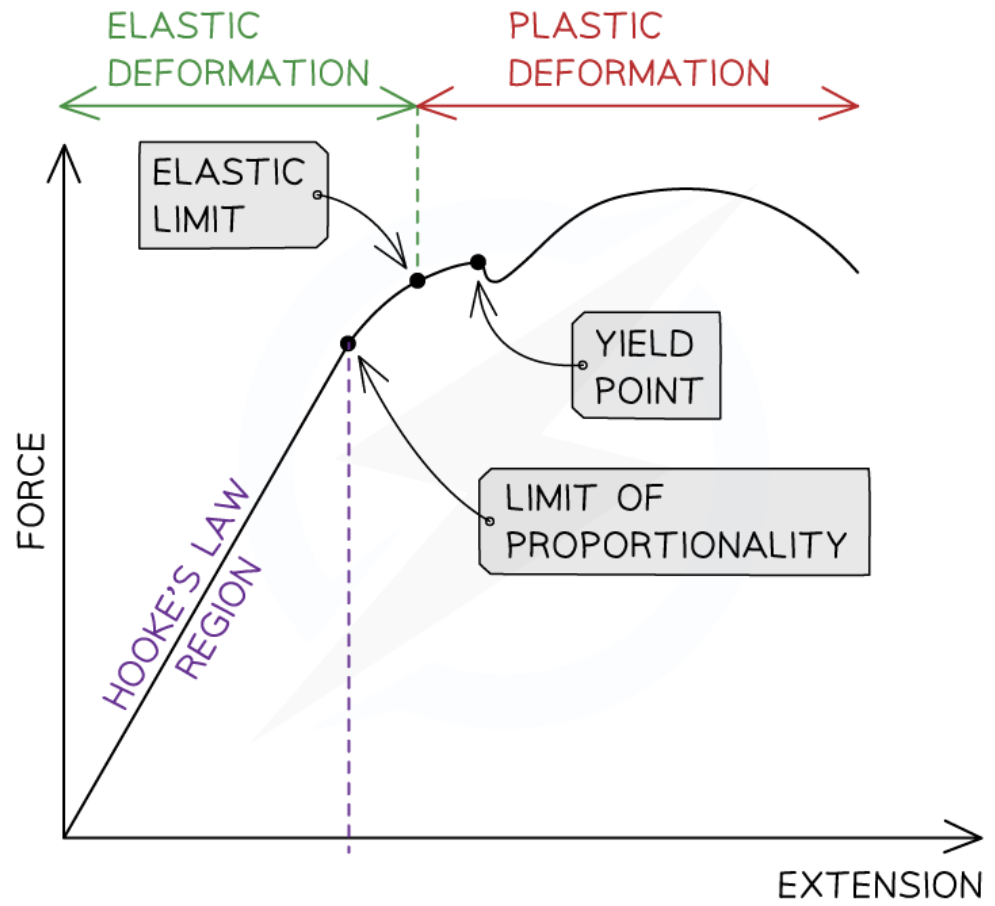
Force-extension graph
Limit of proportionality: the point beyond which Hooke's Law is no longer true
Elastic limit: the point beyond which the material will be permanently deformed, right after limit of proportionality
Brittle materials: extend very little before it breaks / fractures at a low extension
Plastic materials: experience a large amount of extension as the load is increased, especially after the elastic limit
Types of stretches
Elastic
Material returns to original shape once force is removed
All the work done is stored as elastic strain energy
Plastic
Material does not return to original shape once force is removed
Work is done to move atoms apart so some energy is not stored as elastic strain energy but dissipated as heat
Types of deformation
Tensile deformation
Deformation that stretches an object
Compressive deformation
Deformation that compresses an object
Strain energy
The area under the force-extension graph = work done to stretch the energy = strain energy
Elastic strain energy in springs
\(E_{p} = \frac{1}{2} F \Delta L = \frac{1}{2} k (\Delta L)^{2} = \text{area under force-extension graph}\)
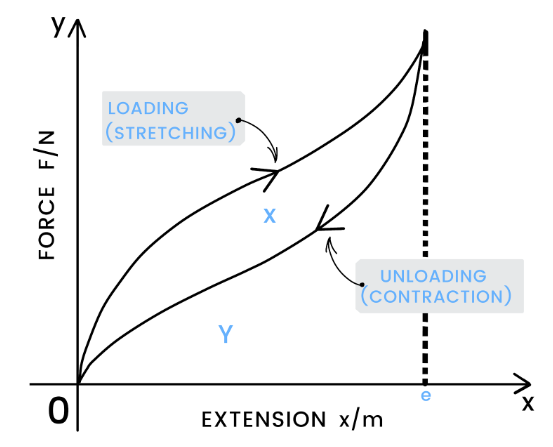
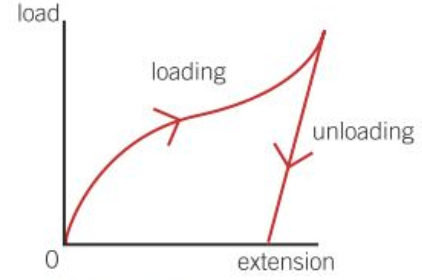
Loading & unloading curve for different materials
Area between loading and unloading curves = work done to permanently deform the material or dissipated as heat
Plastic deformation
When a material is stretched beyond its elastic limit it will not return to its original length after the load is removed (permanent extension / deformation)
Metal wire
Loading (the proportional part) + unloading curves have the same gradient
Gradient of the unloading line remains the same because the stiffness only changes with material
Extension of elastic materials graph e.g. seatbelts
Loading and unloading curves are not linear & not the same
Returns to the original length when unloaded
Extension of plastic materials graph
The loading curve is not linear
During unloading the change in length is greater for a given change in tension
Does not return to its original strength
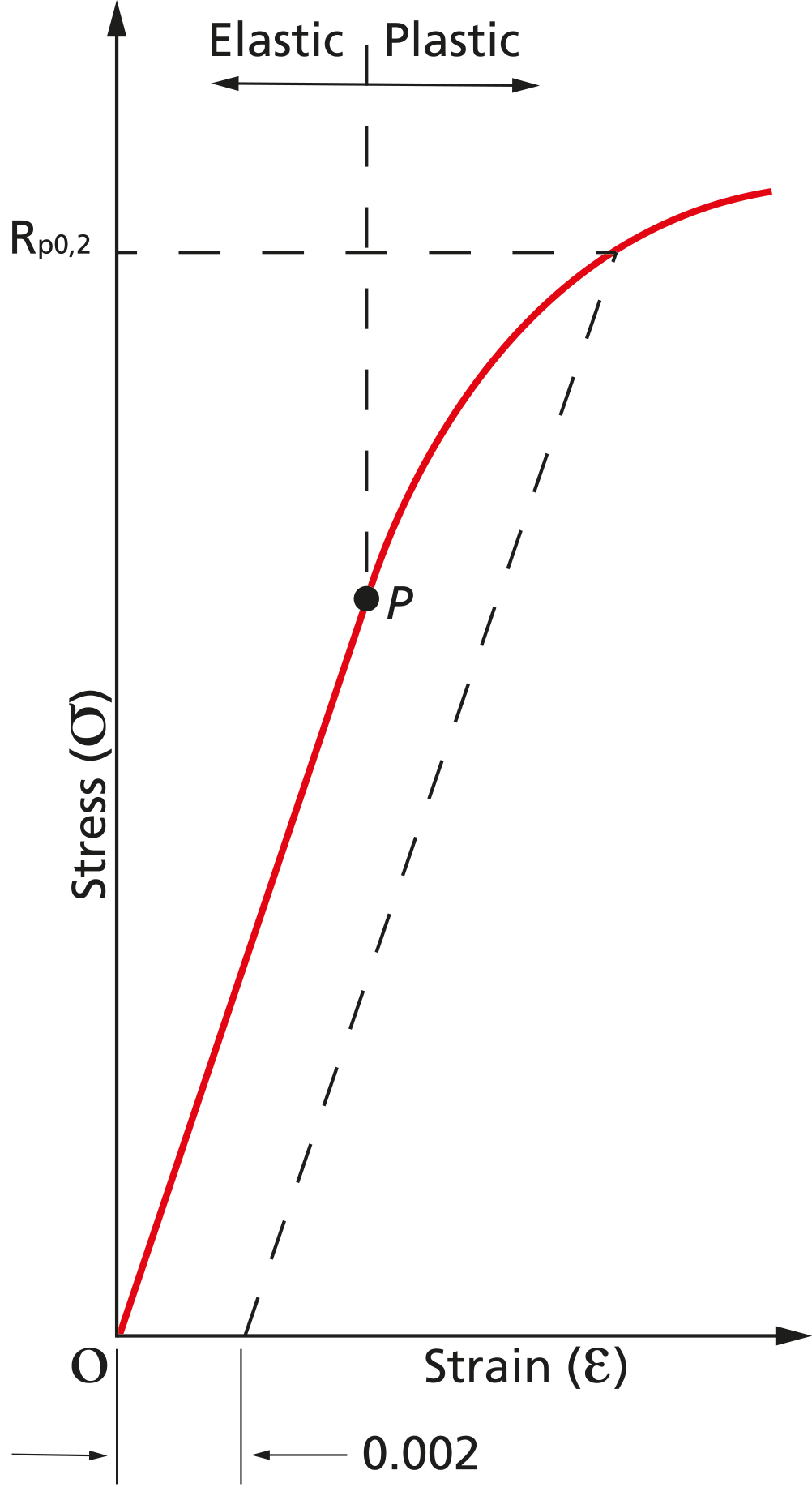
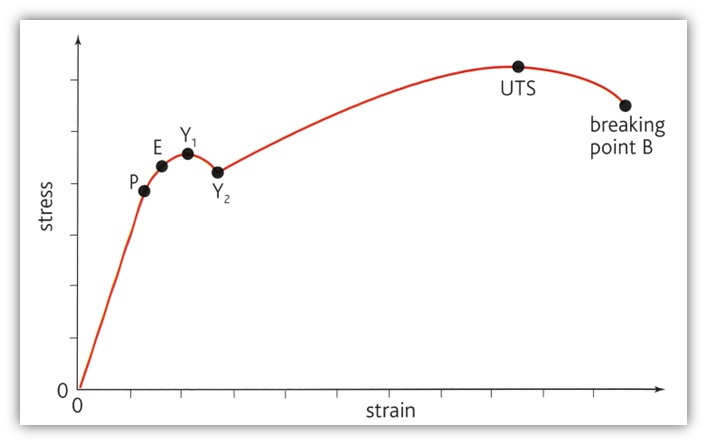
Stress-strain curves
Before limit of proportionality (P)
Gradient = Young modulus of the material
Tensile stress \(\propto\) tensile strain
The material obeys Hooke's law
Elastic Limit (E)
Up to this point the material returns to its original length when the load acting on it is completely removed
Beyond this limit the material doesn't return to its original position after unloading and a plastic deformation starts to appear in it
Yield point (Y1 and Y2)
The stress at which the material starts to deform plastically
After the yield point is passed, plastic deformation occurs
2 yield points: upper (Y1) + lower yield point (Y2)
At the upper yield point the wire weakens temporarily
At the lower yield point a small increase in stress causes a large increase in strain and the wire undergoes plastic flow
Ultimate tensile stress (UTS)
The maximum stress a material can withstand
After UTS the wire loses its strength, extends and becomes narrower at its weakest point
Plastic deformation stops
Fracture / breaking point (B)
The point in the stress-strain curve at which the material breaks / fractures
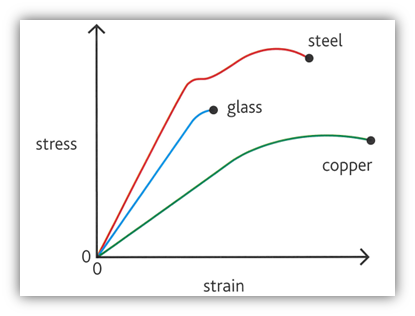
Stress / strain curve for different materials
Brittle materials (e.g. glass) snap without noticeable yield
Ductile materials can be drawn into a wire (e.g. copper)
3.4.2.2 The Young modulus
Tensile strain
Extension per unit length
\(\sigma = \frac{F}{A}\) (Note: \(\sigma\) usually denotes stress, \(\epsilon\) strain. The original text had this swapped. Corrected: \(\epsilon = \text{Strain}\), \(\sigma = \text{Stress}\))