3.2.1 Particles
3.2.1.1 Constituents of the atom
Constituents of an atom
| Particle | Charge (C) | Relative charge | Mass (kg) | Relative Mass | Specific Charge (\(C \cdot kg^{-1}\)) |
|---|---|---|---|---|---|
| Proton | \(+1.6 \times 10^{-19}\) | \(+1\) | \(1.67(3) \times 10^{-27}\) | \(1\) | \(9.58 \times 10^{7}\) |
| Neutron | \(0\) | \(0\) | \(1.67(5) \times 10^{-27}\) | \(1\) | \(0\) |
| Electron | \(-1.6 \times 10^{-19}\) | \(-1\) | \(9.11 \times 10^{-31}\) | \(0.0005\) | \(1.76 \times 10^{11}\) |
Specific charge
- \(\text{specific charge} = \frac{\text{charge}}{\text{mass}}\)
- Unit = \(C \cdot kg^{-1}\)
Nuclide notation
- \(_{Z}^{A}X\)
- \(A\) = nucleon / mass number = number of nucleons (proton + neutron)
- \(Z\) = proton / atomic number = number of protons
- \(X\) = symbol for the element
Isotopes
- Atoms with the same number of protons and electrons but different numbers of neutrons & different atomic masses
Nuclide
- A type of nucleus
Atom and nucleus size
- Size of atom \(\approx 10^{-10} \text{ m}\)
- Size of nucleus \(\approx 10^{-15} \text{ m} = 1 \text{ fm}\)
3.2.1.2 Stable and unstable nuclei
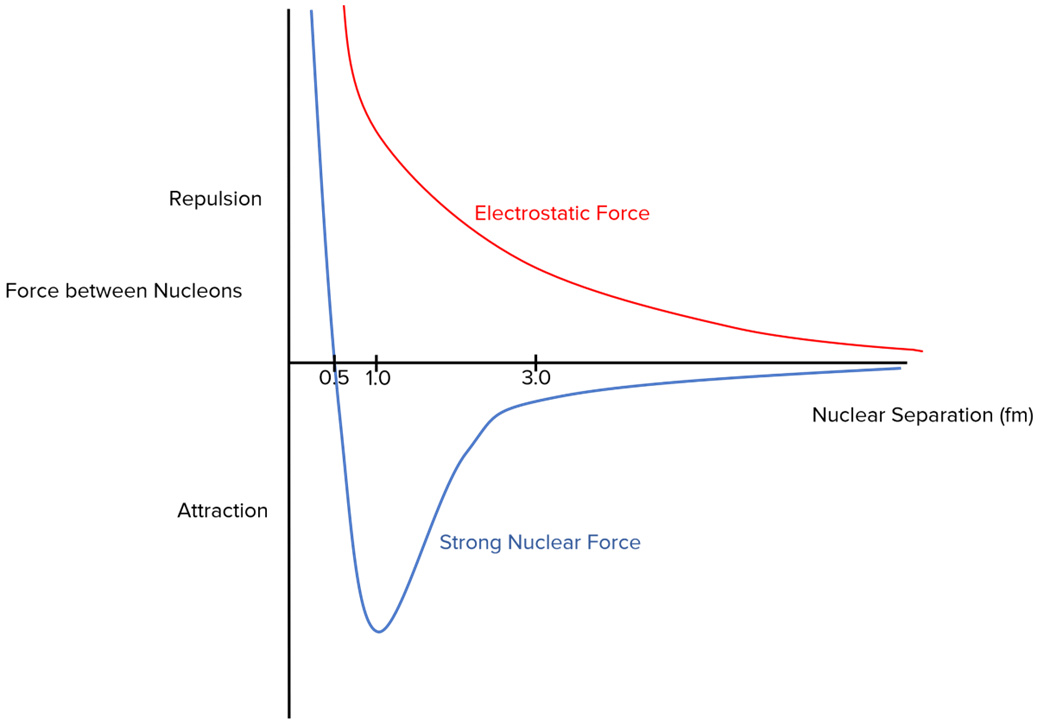
The strong nuclear force (SNF)
- Only affects hadrons
- Acts on nucleons
- Keeps the nucleus stable by counteracting the electrostatic force of repulsion between protons in the nucleus and keeping protons and neutrons together
- Prevents proton and neutron from moving closer or further apart
- Very short range
- Repulsion for separations less than about 0.5 fm
- Attraction for separations up to 3 fm (1 fm = \(10^{-15}\) m)
- Negligible beyond 3 fm
- Exchange particles = pions / gluons
- Much larger in magnitude compared to other fundamental forces
Unstable nuclei
- Too many protons and / or neutrons
- SNF not enough to keep them stable
- Decay in order to become stable (type depends on the amount of each nucleon)
Alpha decay
- Too many protons and neutrons
- Alpha particle emitted (2 protons + 2 neutrons)
- \(_{Z}^{A}X \rightarrow _{Z - 2}^{A - 4}Y + _{2}^{4}\alpha\)
Beta-minus decay
- Too many neutrons (neutron-rich)
- A neutron changes into a proton
- Fast-moving electron (beta particle) + an electron antineutrino (antiparticle with no charge) emitted
- \(_{Z}^{A}X \rightarrow _{Z + 1}^{A}Y + _{- 1}^{0}\beta + \bar{\nu}_{e}\)
Neutrino (\(\nu\))
- At first scientists believed that only an electron was emitted from the nucleus during beta-minus decay
- Observation of energy levels before + after decay showed that energy was not conserved (some energy was lost)
- Neutrinos were hypothesised for the loss of energy and later observed
Why is collaboration important to making advances in understanding of particle physics
- Results of experiments must be independently checked/validated/peer reviewed before they are accepted/can be confirmed
- Particle accelerators are very expensive and collaboration helps to spread the cost of building them
- Many skills and disciplines are required which one team are unlikely to have
- Lots of data to process so more teams are needed
3.2.1.3 Particles, antiparticles and photons
EM radiation
- Emitted when charged particles lose energy
- When a fast-moving electron is stopped / slows down / changes direction
- When an electron in a shell of an atom moves to a different shell of lower energy
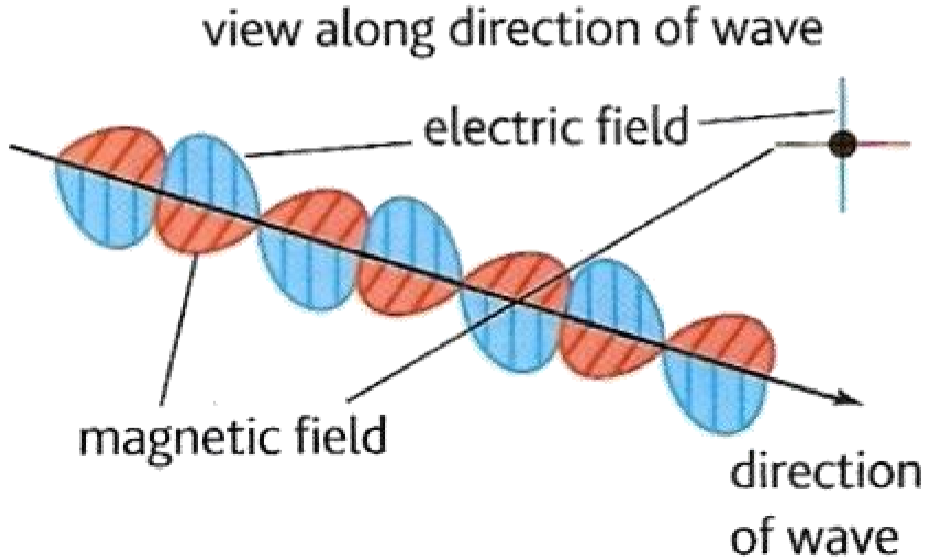
- Consists of two linked electric and magnetic field waves that are at right angles to each other and in phase
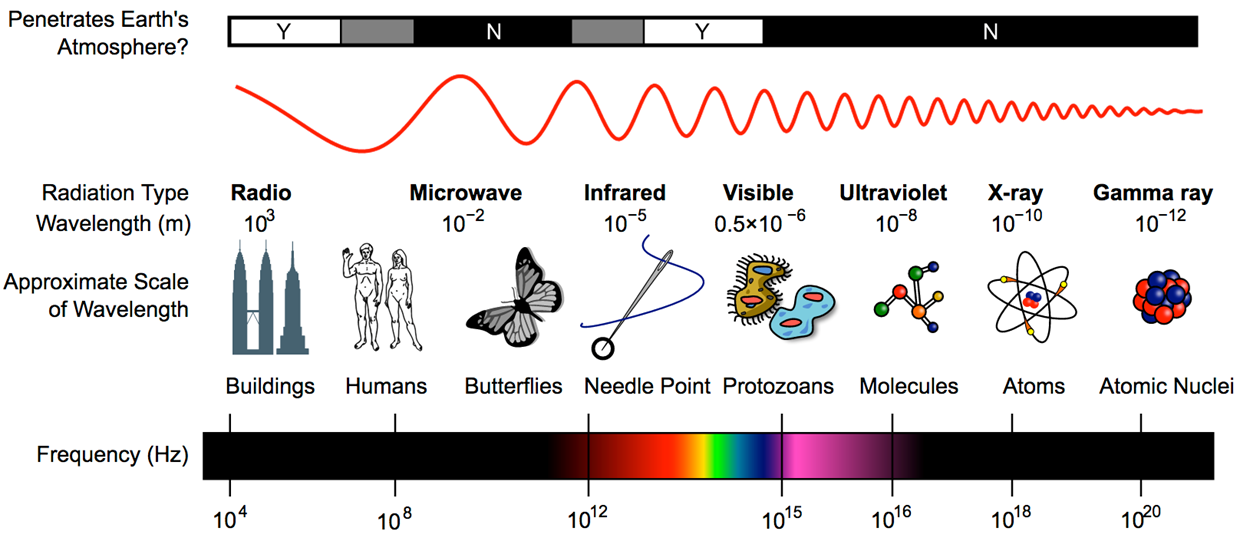
The electromagnetic spectrum
Photon model of EM radiation
- EM waves are emitted as short burst of waves in different directions
- Each burst = a packet of EM waves = a photon
- Photons transfer energy and have no mass
- The energy of the photons is directly proportional to the frequency of EM radiation
- \(E = hf = \frac{hc}{\lambda}\)
- \(h\) = Planck constant = \(6.63 \times 10^{-34} \text{ Js}\)
Electron volts
- 1 electron volt = the energy transferred when an electron is moved through a p.d. of 1 V
- \(1 \text{ eV} = 1.60 \times 10^{-19} \text{ J}\) (\(1 \text{ MeV} = 1.60 \times 10^{-13} \text{ J}\))
Antiparticle
- All particles of normal matter have a corresponding antiparticle
- Same rest energy and mass as the particle
- All other properties are opposite e.g. charge / strangeness
- Will undergo annihilation with the normal particle if they meet
Types of antiparticles
| Particle | Antiparticle |
|---|---|
| Electron | Positron |
| Proton | Antiproton |
| Neutron | Antineutron |
| Neutrino | Antineutrino |
Annihilation
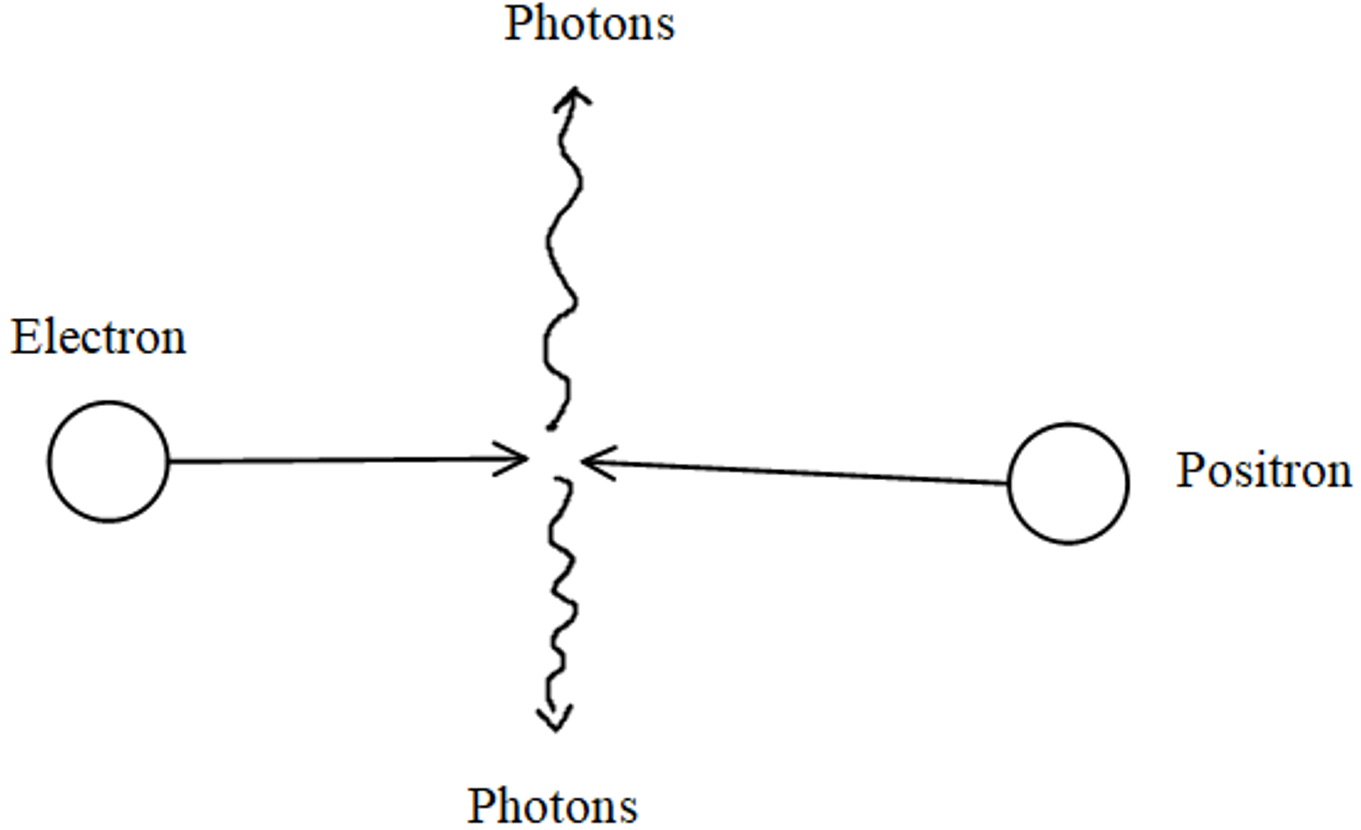
- Where a particle and a corresponding antiparticle meet
- All their mass and KE is converted into two gamma photons of equal frequency moving in opposite directions (to conserve momentum)
- Energy and momentum is conserved in the process
- Minimum energy of a single photon = rest energy of the particle
Pair production
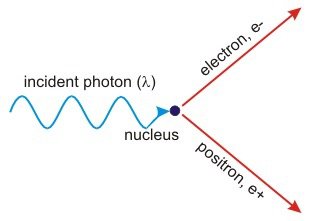
- A photon is converted into a particle and a corresponding antiparticle
- Can only occur when the photon has an energy greater than the total rest energy of both particles
- Minimum energy of a photon needed: \((hf)_{min} = 2 \times \text{rest energy} = 2E_{0}\)
- Excess energy is converted into KE of particles
3.2.1.4 Particle interactions
Four fundamental interactions
| Interaction | Exchange particle / gauge bosons | Range (m) | Acts on | Strength |
|---|---|---|---|---|
| Strong nuclear | Pions (particles) Gluon (quarks) |
\(10^{-15}\) | Hadrons | 1st |
| Weak nuclear | W boson (\(W^{+}\) or \(W^{-}\)) | \(10^{-18}\) | All particles | 3rd |
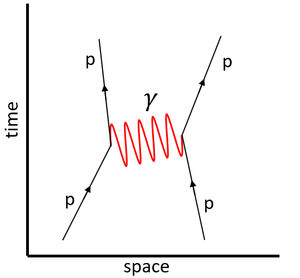
| Electromagnetic | Virtual photon (\(\gamma\)) | Infinite | Charged particles | 2nd |
| Gravity | Graviton | Infinite | Particles with mass | 4th |
Exchange particles
- The force carrier for fundamental forces
- Moves between the particles affected by the force and create the forces
- Transfer energy, force, momentum, and (sometimes) charge between the particles experiencing the force
- Each fundamental force has its own exchange particles
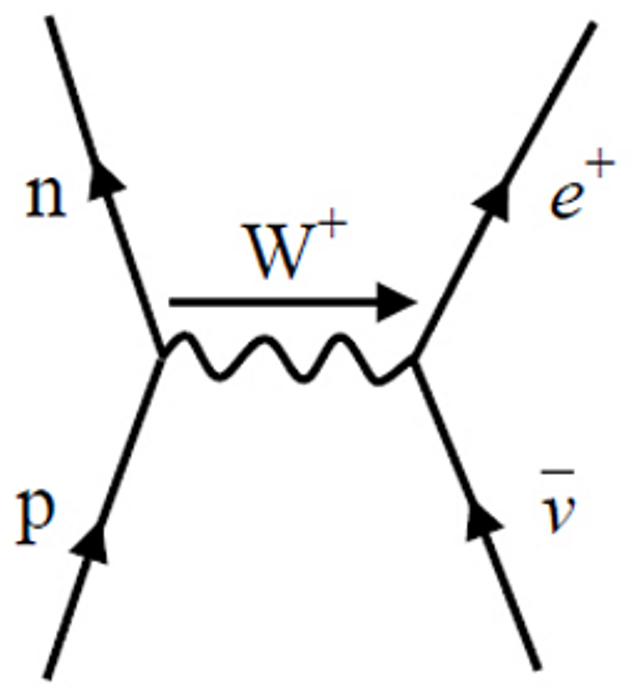
The weak nuclear force
- Responsible for beta decay, electron capture and electron-proton collisions
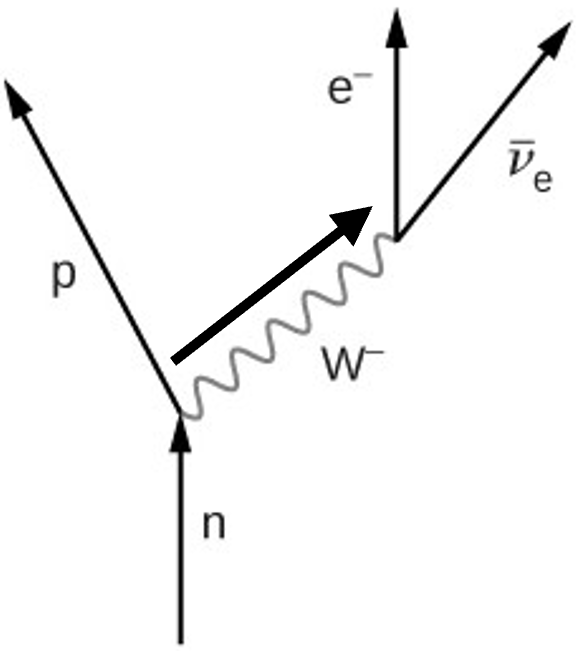
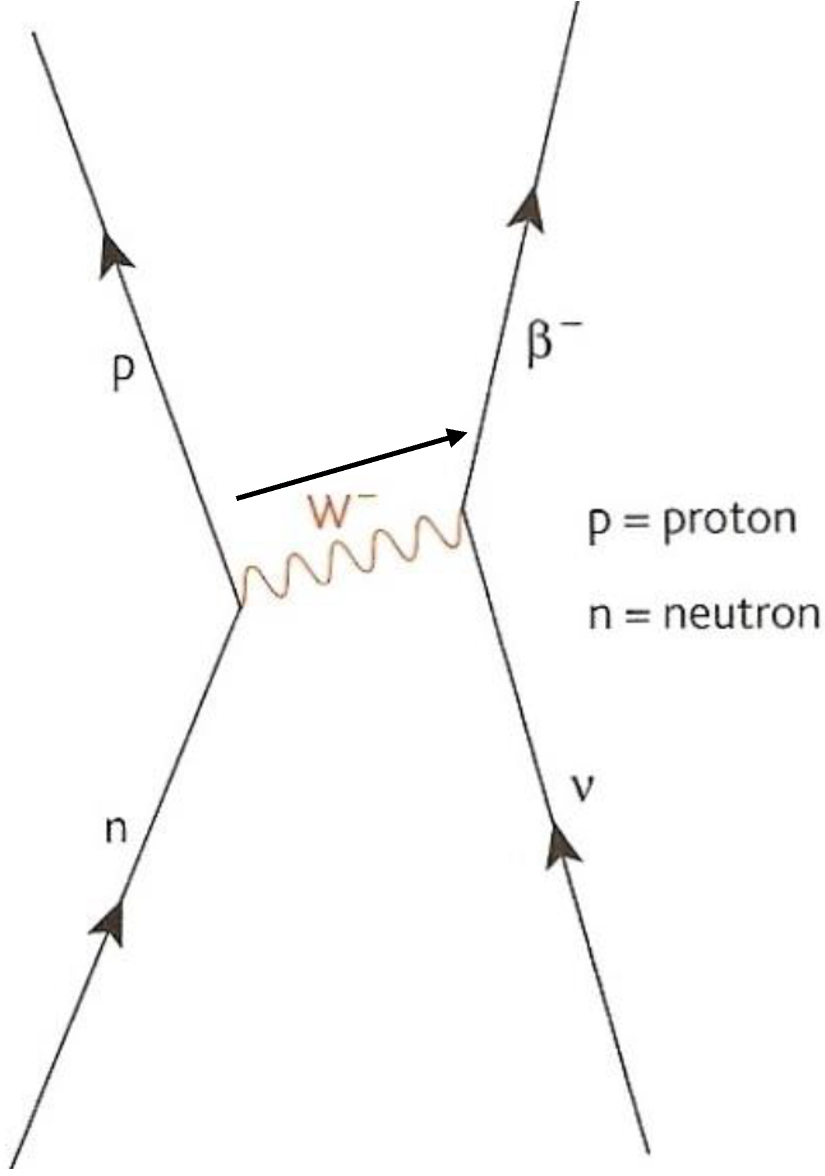
- Exchange particles = W bosons (\(W^{+}\) or \(W^{-}\))
- Non-zero rest mass
- Very short range \(\le 0.001 \text{ fm}\) (\(10^{-18} \text{ m}\))
- Positively or negatively charged
Weak interactions
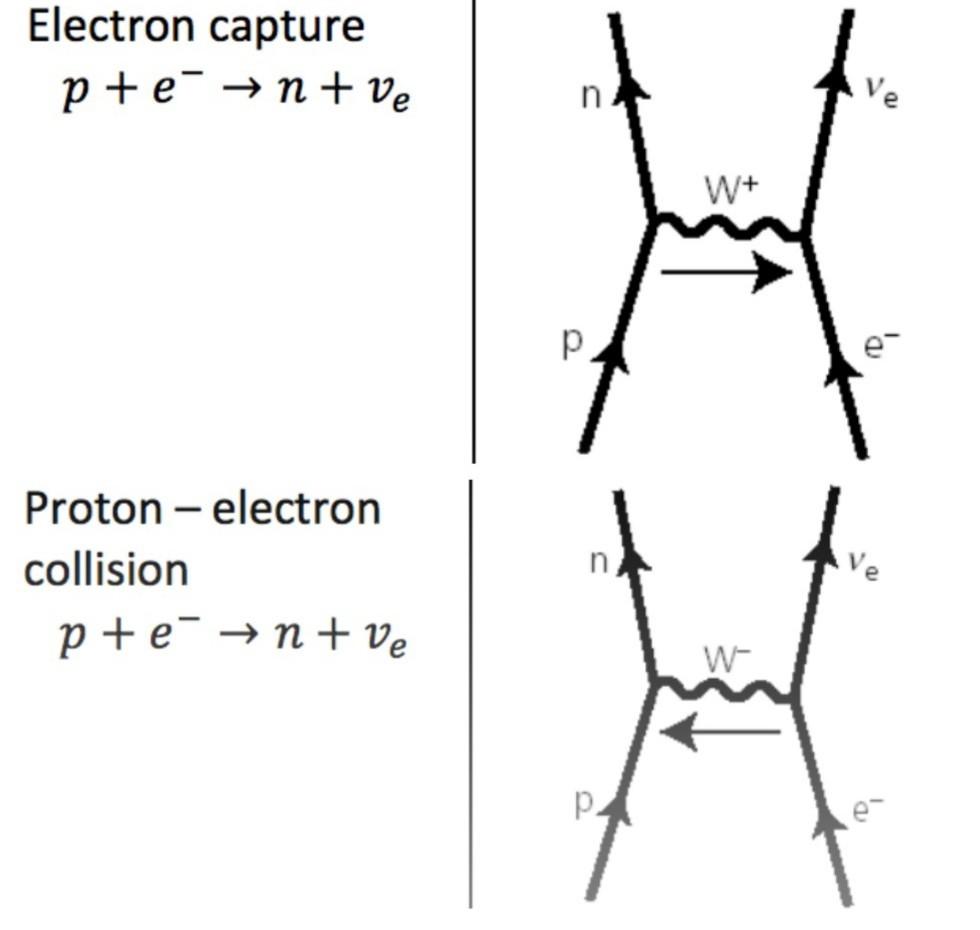
- Electron capture (electron-proton collisions)
- Same equation + different exchange particle
- \(p + e^{-} \rightarrow n + \nu_{e}\)
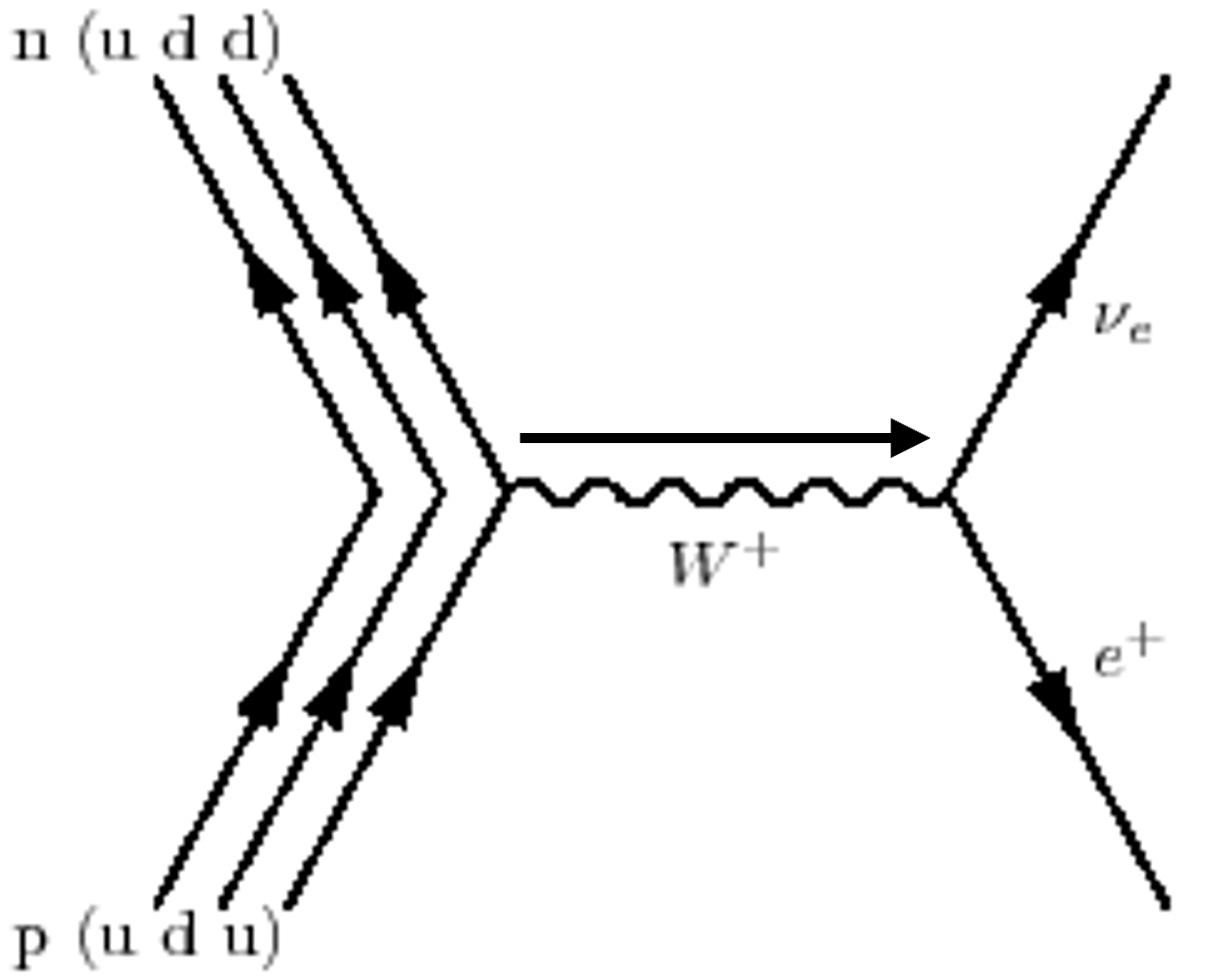
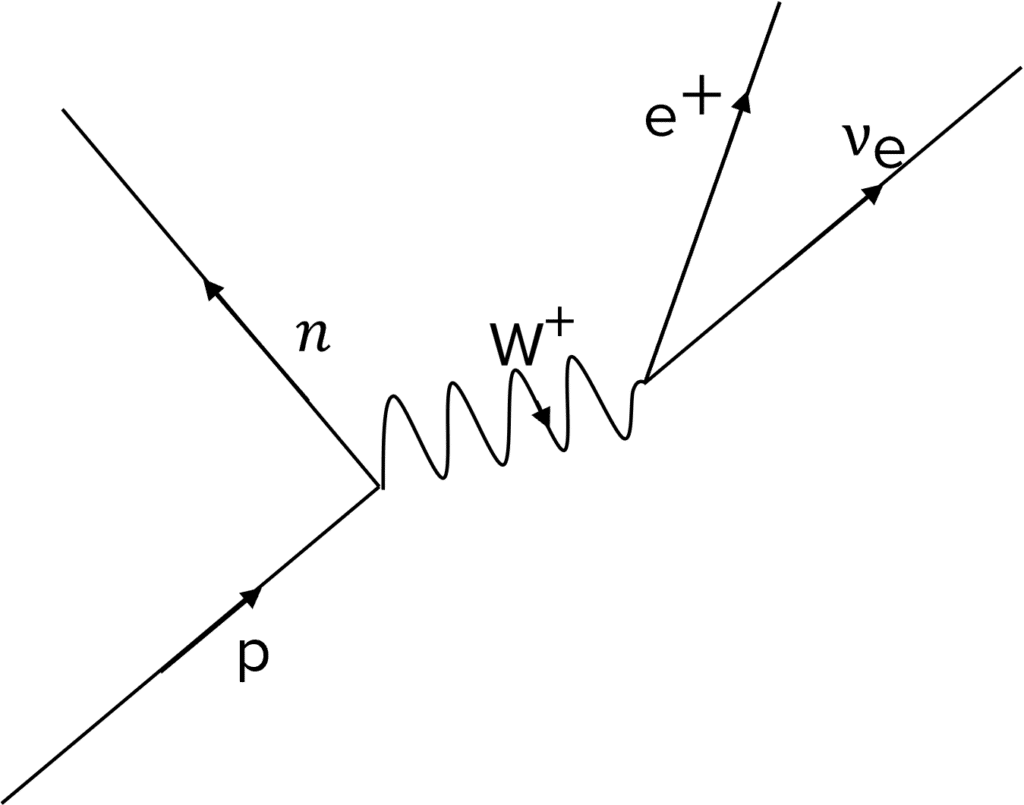
- Beta-plus decay
- \(p \rightarrow n + e^{+} + \nu_{e}\)
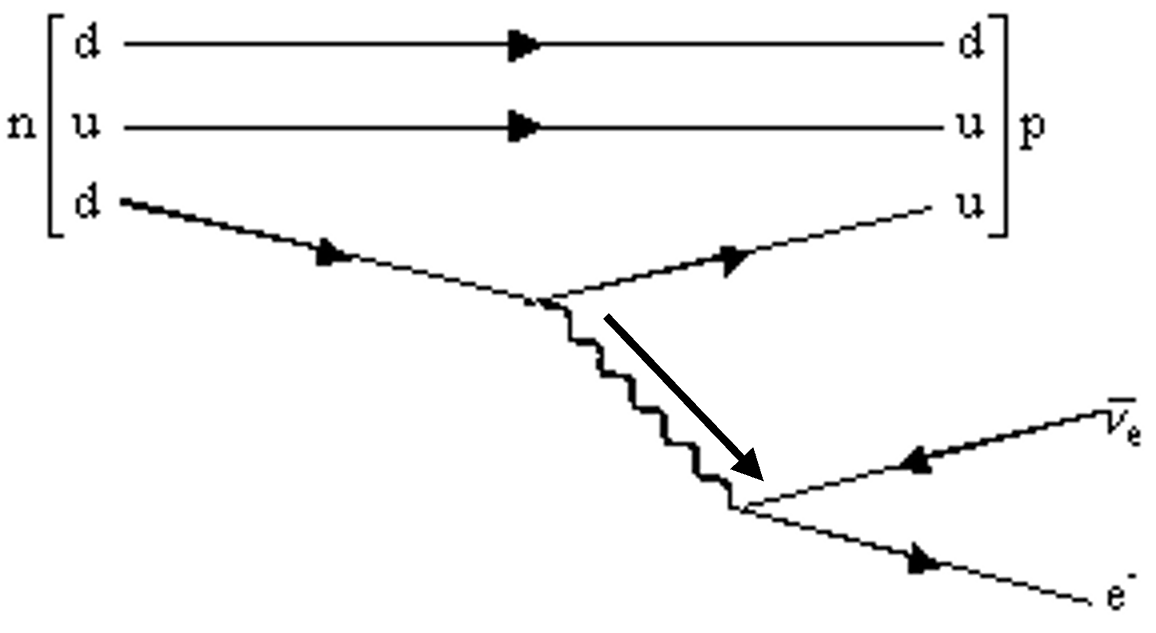
- Beta-minus decay
- \(n \rightarrow p + e^{-} + \bar{\nu}_{e}\)
- Neutron-neutrino interaction
- Proton-antineutrino interaction
- Electrostatic interactions
3.2.1.5 Classification of particles
Deducing whether is strong interaction or not
- Leptons present: must be weak
- Leptons not present: strong or weak
- Strangeness not conserved: must be weak
Classifying particles
- All particles are either hadrons or leptons
- Leptons
- Fundamental particles - cannot be broken down any further
- Interacts via weak interaction only
- Hadrons
- Formed of quarks (fundamental particles)
- Interact through weak or strong interaction
- Both experiences gravitational interaction and electromagnetic interaction (if charged)
Types of hadrons
- Baryons / antibaryons
- Mesons
Baryons / antibaryons
- Hadrons that are formed of 3 quarks (3 antiquarks for antibaryons)
- Proton is the only stable baryon
- All other baryons eventually decay into protons
- (Neutrons are also baryons)
Mesons
- Formed of 1 quark + 1 antiquark
- Hadrons that do not include protons in their decay products
- Very short life time (annihilate almost immediately) + all unstable
- Pion / \(\pi\) meson
- The lightest and most stable meson
- Produced in high energy particle collisions, discovered in cosmic rays
- Exchange particle for SNF
- Different charges: \(\pi^{+}\), \(\pi^{-}\), \(\pi^{0}\)
- Kaon / \(K\) meson
- Heavier + less stable
- Produced by the strong interaction between pions and protons
- Eventually decay into pions (many possibilities)
- Different charges: \(K^{+}\), \(K^{0}\), \(K^{-}\)
Baryon number
- 1 = baryon / -1 = antibaryon / 0 = not a baryon
- A quantum number
- Always conserved in particle interactions
Types of leptons
- Electron (\(e^{-}\))
- Relative charge = -1
- Electrons and their neutrinos / antiparticles are the only stable leptons
- Positron (\(e^{+}\))
- Will eventually encounter an electron and annihilate
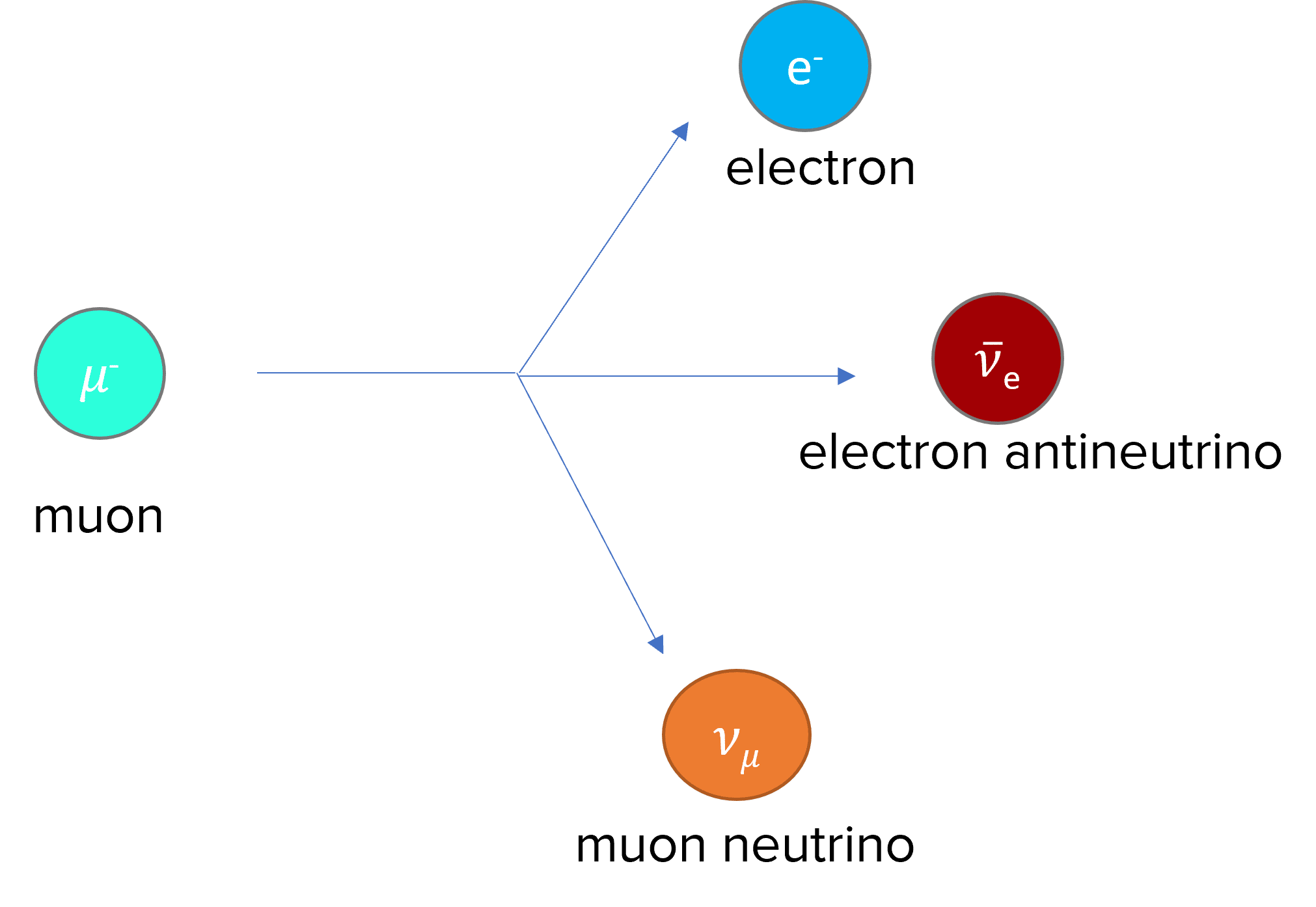
- Muon (\(\mu^{-}\))
- Heavier than electrons
- More unstable
- Relative charge = -1
- Muons decay into electrons by weak interaction: \(\mu^{-} \rightarrow e^{-} + \bar{\nu}_{e} + \nu_{\mu}\)
- Antimuon (\(\mu^{+}\))
- Antimuon (\(\mu^{+}\)) decays into positions: \(\mu^{+} \rightarrow e^{+} + \nu_{e} + \bar{\nu}_{\mu}\)
- Neutrinos (\(\nu_{e}\), \(\nu_{\mu}\))
- Negligible mass & 0 charge
- The most abundant leptons in the universe
- Tauons and & their neutrinos (not required to know)
Lepton number
- Gives the number of leptons
- 1 = lepton, -1 = antilepton, 0 = not a lepton
- Conserved during reactions
Strangeness
- A quantum number
- Reflect the fact that strange particles are always created in pairs
- Explain why some particle interactions take place more slowly than others / do not occur at all
- Always conserved in strong interactions
- Change by 0, +1 or -1 in weak interactions
Strange particles
- Particles which are produced by the strong nuclear interaction but decay by the weak interaction
- Strange particles are created in twos
- e.g. kaons (decay into pions through the weak interaction)
- Assume all others are non-strange particles
- Particles with strange quarks have long lifetimes
Investigating particle physics
- Particle accelerators may be built
- These are very expensive + produce huge amounts of data
- Scientific investigations rely on collaboration of scientists internationally
3.2.1.6 Quarks and antiquarks
Quarks
- Baryons and mesons are composed of quarks
- Quarks feel the strong force
- Quarks are always found in pairs or triplets
Combination of quarks and antiquarks in baryons / antibaryons
| Particle | Combination | Baryon number | Strangeness |
|---|---|---|---|
| \(p\) | \(uud\) | \(1\) | \(0\) |
| \(n\) | \(udd\) | \(1\) | \(0\) |
| Antiproton | \(\bar{u}\bar{u}\bar{d}\) | \(-1\) | \(0\) |
| Antineutron | \(\bar{u}\bar{d}\bar{d}\) | \(-1\) | \(0\) |
| \(\Sigma^{+}\) | \(uus\) | \(1\) | \(-1\) |
| \(\Sigma^{0}\) | \(uds\) | \(1\) | \(-1\) |
| \(\Sigma^{-}\) | \(dds\) | \(1\) | \(-1\) |
Combination of quarks and antiquarks in mesons
| Particle | Combination | Charge (e) | Strangeness | Baryon number |
|---|---|---|---|---|
| \(\pi^{0}\) | \(u\bar{u}\) or \(d\bar{d}\) | 0 | 0 | 0 |
| \(\pi^{+}\) | \(u\bar{d}\) | +1 | 0 | 0 |
| \(\pi^{-}\) | \(\bar{u}d\) | -1 | 0 | 0 |
| \(K^{0}\) | \(d\bar{s}\) or \(\bar{d}s\) | 0 | \(d\bar{s} = +1\), \(\bar{d}s = -1\) | 0 |
| \(K^{+}\) | \(u\bar{s}\) | +1 | +1 | 0 |
| \(K^{-}\) | \(\bar{u}s\) | -1 | -1 | 0 |
Strangeness of particles
| Strangeness | Particles |
|---|---|
| \(-3\) | \(\Omega^{-}\) |
| \(-2\) | \(\Xi^{-}\), \(\Xi^{0}\) |
| \(-1\) | \(\Lambda\), \(K^{-}\), \(K^{0}\), \(\Sigma^{+}\), \(\Sigma^{-}\), \(\Sigma^{0}\) |
| \(0\) | \(p\), \(n\), \(\pi^{+}\), \(\pi^{-}\), \(\pi^{0}\) |
| \(1\) | \(K^{+}\) |
Neutron decay
- Decay into proton as neutrons are baryons
- A down quark changes to an up quark
- \(n \rightarrow p + e^{-} + \bar{\nu}_{e}\)
3.2.1.7 Applications of conservation laws
Properties conserved in particle interactions
- Energy and momentum: always
- Reactants rest energy < products rest energy = reactants KE > products KE
- Charge: always
- Baryon number: always
- Electron lepton number: always
- Muon lepton number: always
- Strangeness: only in strong interactions
- All conservation laws obeyed = the interaction is possible
β decay
- β- decay
- A neutron in a neutron-rich nucleus will decay into a proton
- A down quark changes to an up quark
- \(n \rightarrow p + e^{-} + \bar{\nu}_{e}\)
- β+ decay
- A proton in a proton-rich nucleus changes into a neutron
- An up quark changes to a down quark
- \(p \rightarrow n + e^{+} + \nu_{e}\)